

Durable Hospital Wristbands That Last Weeks: Why Material & Coatings Matter
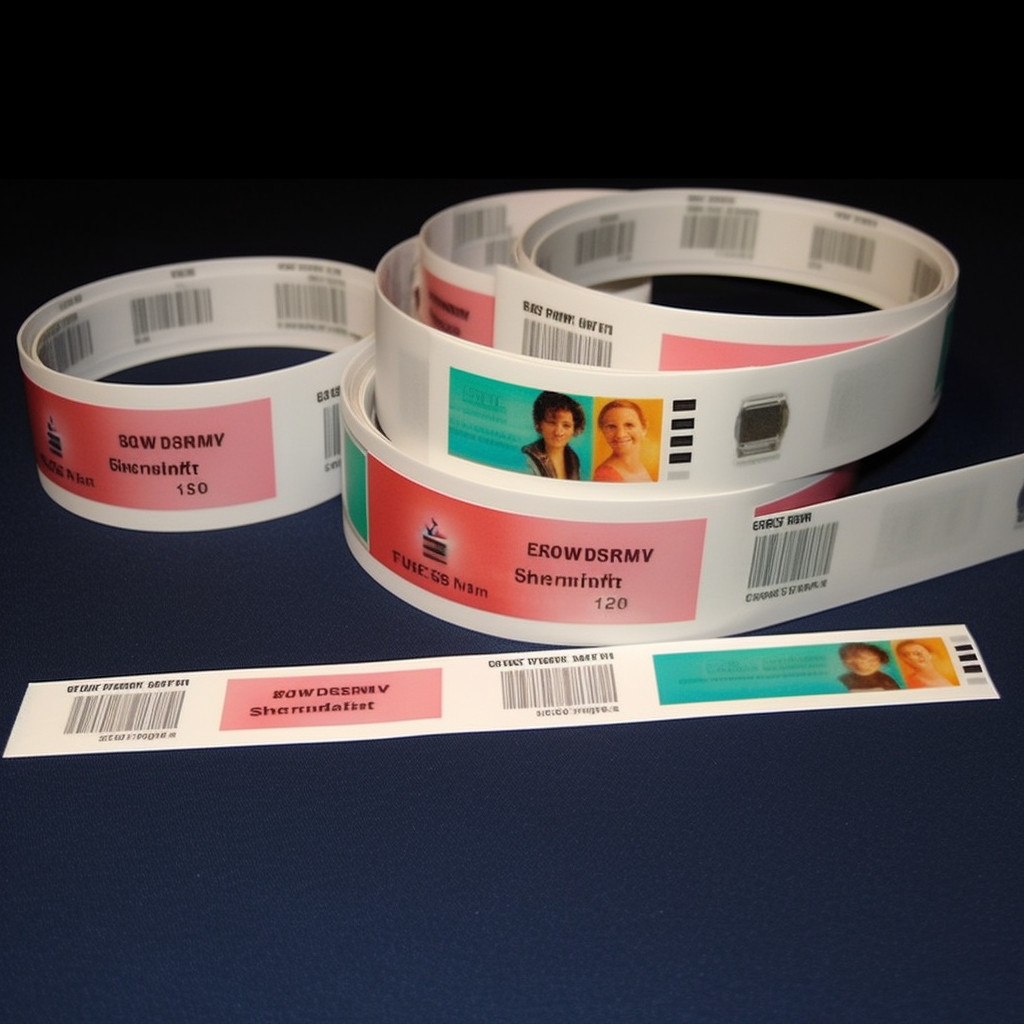
If you want hospital wristbands to last weeks, you’ve got to spec the substrate, topcoat, and closure like a medical laminate and validate them against real stressors. Bands fail when films crack from flex-fatigue, edges tear at die-cuts, print smudges from poor ribbon chemistry, or layers delaminate after moisture and wipes. Require disinfectant compatibility (alcohols, chlorhexidine, peroxide, quats) plus ASTM D4060 abrasion and ISO 10993 conditioning—next you’ll see how to match materials to your workflow.
Week-Proof Hospital Wristbands: Key Durability Criteria
If you expect a hospital wristband to last a whole week, you need durability criteria that map directly to how bands fail on real wrists: abrasion, moisture ingress, chemical exposure, and closure creep. Specify substrate toughness (tear propagation resistance), flex-fatigue endurance, and low water-vapor transmission to protect printed and embedded IDs. Require disinfectant compatibility against alcohols, chlorhexidine, peroxide, and quats, verified by mass change and tensile retention after timed soaks. Define closure performance in terms of creep rate under cyclic tension and torsion. In hospital wristband technology, qualify innovative materials via ISO 10993 and ASTM conditioning protocols.
Why Hospital Wristbands Fail (Cracking, Smudging, Delamination)
When you spec a wristband for multi-day wear, you’ll see cracking start where the substrate can’t tolerate repeated flexing, chemical exposure, or low-temperature brittleness. You’ll also get smudging and ink wear when print chemistry, curing, or abrasion resistance doesn’t meet your handling and disinfection conditions. Finally, delamination shows up when adhesive selection, surface energy, or laminate construction can’t maintain bond integrity under moisture, heat, and mechanical stress.
Common Crack Causes
Although hospital wristbands appear simple, they fail in predictable ways when the material system (substrate, print layer, overlaminate, and adhesive) exceeds its intended chemical, thermal, and mechanical limits. You’ll see cracks when a stiff, low-elongation film gets forced around small radii at the clasp or when die-cut edges concentrate stress. Inadequate plasticizer balance or UV/heat aging raises Tg, embrittles layers, and accelerates microcrack growth. Adhesive over-cure can create a rigid hinge line that fractures under flex. For crack prevention, prioritize material selection validated by flex-fatigue, environmental conditioning, and peel tests to relevant standards.
Smudging And Ink Wear
Cracks show you where the substrate can’t take the strain; smudging and ink wear show you where the print system can’t take the environment. If you see barcode haze, feathering, or density loss, trace it to chemistry, not “handling.” Alcohol wipes, soaps, lotions, and plasticizer migration can re-solvate dyes or soften the resin, thereby reducing smudge resistance. Validate ink longevity with abrasion (Taber), wet rub, and disinfectant exposure, then confirm scan grade per ISO/IEC 15415. Improve outcomes by matching ribbon/ink to face stock energy, adding a hardcoat, and controlling cure, temperature, and dwell.
Layer Separation Issues
Delamination is the telltale fingerprint of a wristband stack-up that can’t hold together under clinical heat, moisture, and flexing. You’ll see edges curl, laminates blister, and print layers lift after alcohol wipes, showers, and long wear. When layer adhesion is weak, sweat-driven hydrolysis and disinfectant plasticization reduce interfacial strength, and then peel stresses finish the job. Repeated bending accelerates material fatigue in films and pressure-sensitive adhesives, creating microcracks that propagate between layers. Validate with ASTM peel and shear tests, then redesign: corona treat substrates, tune primer chemistry, and select compatible topcoats.
Hospital Wristband Materials Compared (Vinyl, PP, Tyvek, Silicone)
When comparing vinyl, PP, Tyvek, and silicone wristbands, you should start by assessing how each substrate holds up to tensile stress, flex cycles, moisture, and disinfectants without cracking or tearing. You also need to verify comfort and skin safety by checking edge finish, breathability, and ISO 10993 biocompatibility to ensure irritation doesn’t become a failure mode. Finally, you can’t ignore print-and-scan performance—test thermal/laser/ink adhesion, smudge and chemical resistance, and barcode/QR code readability after abrasion and wipe-downs.
Durability By Material
Although all hospital wristbands are designed to withstand moisture, friction, and routine disinfecting, material choice largely determines the dominant failure mode you’ll see in service: vinyl typically fails due to plasticizer loss and edge cracking after repeated alcohol wipes. PP resists chemicals but can stress-whiten and tear at perforations under cyclic flex. Tyvek excels in tear propagation resistance, yet delaminates at print or adhesive interfaces when saturated, so you must validate bond strength. Silicone withstands fluids and heat, but can abrade or pick up particulate, degrading legibility. Specify ASTM/ISO-aligned durability testing and drive material innovation with exposure-and-flex protocols.
Comfort And Skin Safety
Comfort is a wear-interface problem, so you should evaluate hospital wristbands the way you’d audit any skin-contact component: friction, edge geometry, moisture occlusion, and extractables under realistic wear and cleaning cycles. Vinyl can plasticize, raising the risk of skin irritation under occlusion; specify low-extractables and ISO 10993 evidence. PP is stiffer, so edge finishing and hinge design control pressure points. Tyvek breathes, improving patient comfort, but fibers can abrade if poorly laminated. Silicone excels at long wear, but you must verify catalyst residues and the compatibility of cleaners.
- Measure COF wet/dry
- Radius edges
- Test sweat/soap exposure
- Screen sensitizers
Print And Scan Performance
Because scan reliability fails long before a wristband “wears out,” you should qualify print/scan performance as a materials-and-process system: surface energy and porosity (ink anchorage), dimensional stability (bar width growth), chemical resistance (alcohol/soap/CHG wipe-down), and optical contrast after abrasion and moisture cycling. Vinyl often accepts thermal-transfer ink well, but can plasticize-bloom, lowering print quality. PP needs corona/primer; otherwise, ribbon adhesion and scanning efficiency drop after wipe-downs. Tyvek’s porous web enhances anchorage but risks fiber fuzzing, which degrades edge acuity. Silicone resists chemicals, but low surface energy demands specialized inks and topcoats.
Wristband Coatings That Protect Print and Barcodes
When a wristband’s printed data or barcode smears, fades, or delaminates under cleaning agents and abrasion, the coating—not the base film—usually fails first. You should treat the topcoat as a functional layer that locks pigment/thermal chemistry, controls surface energy, and resists scuff-driven microcracking that breaks barcode readability. In wristband technology, evaluate coatings against ISO/IEC 15415-grade metrics after controlled rub-and-flex cycles, then inspect under microscopy for crazing, edge lift, and gloss loss.
- Hardcoat vs. soft-touch: pick by wear mode
- Primer/topcoat adhesion stack integrity
- Low-friction surfaces to cut shear
- Optical clarity for scanner contrast
Chemical and Sanitizer Resistance: What to Test For
How do you know a wristband won’t fail the moment it meets alcohol wipes, chlorhexidine, iodine, or quats? You test beyond “looks fine” and quantify degradation under controlled chemical exposure. Build a panel that matches your formulary: 70% IPA, CHG, povidone-iodine, quat sprays, and hand-sanitizer gels with emollients. Measure swelling, whitening, embrittlement, adhesive creep, laminate lift, and print/barcode contrast loss pre/post exposure. Use repeat-dose cycles and dwell times aligned to internal protocols or ISO 10993 risk thinking. Demand sanitizer compatibility data from suppliers, not marketing.
Water, Friction, and Abrasion: Real-World Wear Factors
Even if your wristband survives chemical wipes, it can still fail under the daily triad of water exposure, rubbing, and abrasive contact, so you need wear testing that targets the actual failure modes. Water absorption swells polymers, lowers modulus, and opens microcracks; then abrasion removes coatings and blurs print. You should quantify friction resistance under wet and dry cycles, and document edge-wear, delamination, and adhesive creep using repeatable protocols (e.g., ASTM D1894 for COF; ASTM D4060 for abrasion), plus microscopy and mass loss:
Track:
- Wet cycling time-to-fade
- COF drift
- Coating loss
- Strap edge fray
How to Choose Durable Hospital Wristbands for Your Workflow
Although durability sounds like a materials problem, you’ll choose the right hospital wristband faster by mapping your workflow’s dominant failure modes to verified test data. Start your wristband selection process by listing exposure vectors: hand-sanitizer chemistry, bathing cycles, tape adhesion, glove friction, and scanner heat. Then require supplier evidence: ISO 105 colorfastness, Taber abrasion loss, tensile/tear strength, and adhesive shear at temperature and humidity. Match substrates (PP, PET, TPU) and topcoats (UV-cured, silicone) to those stressors. Validate with pilot lots, barcode-grade scans after wear, and feedback loops to optimize the workflow.
Conclusion
You’re watching a wristband ride through weeks of showers, sanitizer rubs, linen pulls, and IV snags. If it cracks, smears, or delaminates, your ID chain breaks. Choose materials by failure mode: vinyl for flexibility, PP for toughness, Tyvek for breathability, silicone for long wear. Demand coatings that lock in ink, protect barcodes, and meet chemical-resistance specs. Test against alcohol, CHG, bleach, water, and abrasion—then standardize what passes.